
My journey
My peptide journey: what I learned and what's still unknown
Peptides helped me. They also come with real unknowns. You deserve both sides.
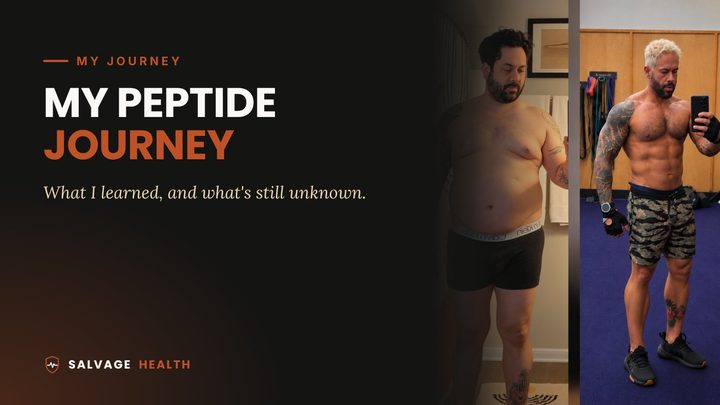
I talk about this openly because it's part of my story. Peptides have been part of my own health journey. I used them while recovering from a shoulder injury, to help my sleep, and to support my body while I was losing fat and building muscle.
But I want to be just as open about this: they were never the main event. They were an addition to the fundamentals, not a replacement for them. Calories, protein, training and sleep did the heavy lifting. Without those, no peptide would have made a difference.
What a peptide actually is
A peptide is a short chain of amino acids, the same building blocks that make up protein. Think of amino acids as letters, peptides as short words, and proteins as long sentences. Your body makes and uses peptides all the time as signals that tell cells what to do. Insulin is one.
When people talk about peptides in fitness, they usually mean a handful of specific compounds used for things like recovery, sleep, growth hormone signaling or appetite. And that group is not one thing. It ranges from fully FDA-approved prescription drugs to substances with very little human research behind them.
What the science shows, and what it doesn't
Some of the popular recovery peptides have promising results in animal and lab studies: tissue repair, gut healing, reduced inflammation. That's real research, and it's why there's so much interest.
But animal studies are a long way from proof in people. For most of these compounds, there are few or no large, well-controlled human trials showing what's safe and what dose works. "Looks promising in rats" is not the same as "known to be safe and effective in humans," and that gap is where a lot of the online hype lives.
Where the rules stand right now
This is changing fast, so here's where things stood as of this article:
- Some peptides are FDA-approved drugs. The GLP-1 medications like semaglutide and tirzepatide went through full clinical trials and are prescribed by doctors.
- Most recovery peptides are not approved. In July 2026, an FDA advisory committee voted in favor of allowing six peptides, including BPC-157 and TB-500, to be used by compounding pharmacies. That vote was a recommendation only. The FDA still has to decide and go through formal rulemaking, and legal experts note there's no set timeline. Until then, those peptides are not on the list compounding pharmacies can legally use.
- "Research chemical" vials are a different risk. Many peptides are sold online labeled "for research only." Those aren't made to the standards required for human medicine, so you can't be sure what's in the vial, how much, or how clean it is.
- Athletes, take note: several popular peptides are banned under World Anti-Doping Agency rules, whatever their FDA status.
What I'd tell a friend
- Fundamentals first. If your sleep, protein and training aren't dialed in, start there. That's where most of the results are.
- Talk to a doctor who actually knows this space. Not a forum, not a vendor, not an influencer. A licensed physician can look at your history and tell you what's appropriate and legal for you.
- Don't buy "research use only" products to inject. Quality is the biggest unknown, and it's the easiest risk to avoid.
- Be skeptical of big promises. Anyone selling a peptide as a shortcut is selling you the same thing every fad diet sold me for years.
My personal opinion is that the research and the rules will keep moving toward better human data and more mainstream access. That's my outlook, not a settled fact. The experts are genuinely split.
This is my story, not medical advice. I'm not a doctor, and nothing here is a recommendation to use any peptide. Everyone's health picture is different. Talk to a licensed physician before you make any decision about this.
I go deeper on all of this, including a full breakdown of what's known and unknown, in Chapter 20 of Fitness Without the Fear.
Free. Instant access. No spam, unsubscribe anytime. See our privacy policy.
Not sure where to start? Take the free 3-minute Salvage Check.