

Meal prep
How to meal prep for a week in two cook days
Restaurants don't cook every meal from scratch. They prep, then they finish. Here's that system, scaled to one fridge.
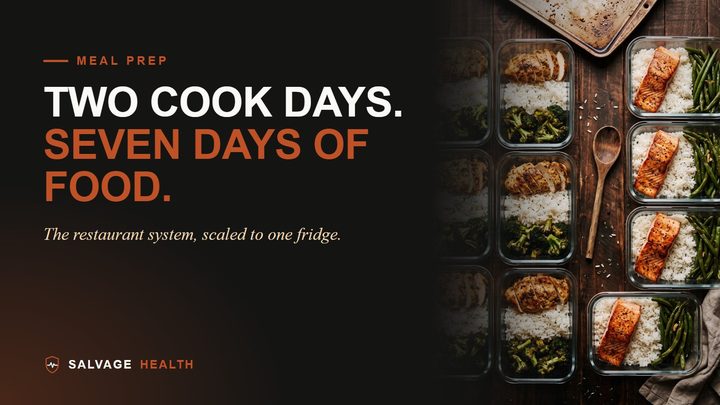
Most meal prep dies on Wednesday. You spend Sunday afternoon filling containers, you feel organized, and by the middle of the week the chicken is dry, the rice is a brick, and you're ordering food you didn't plan to eat. I did that loop for years. The fix wasn't more prep. It was a second cook day.
I ran restaurant kitchens before I ever thought about my own health. No kitchen cooks a plate from zero at 6 pm on a Friday. The sauces, the stocks, the roasted vegetables and the proteins are prepped ahead, in batches, and the cook on the line finishes them to order. That's the whole trick. When I finally lost over 80 pounds, the way I ate was built on that same system, just scaled down to one fridge and one person who gets home tired.
Why one cook day fails
Two reasons, and they're both fixable.
The first is food safety. The USDA's guidance is that cooked leftovers are good for three to four days in the fridge. Chicken you cooked on Sunday is at the edge by Thursday and past it by Friday. One cook day asks food to last longer than it should.
The second is boredom. Eating the same plate five days in a row works for about three of them. After that you start negotiating with yourself, and the drive-through usually wins the negotiation.
A second cook day on Wednesday solves both. Nothing sits in the fridge longer than four days, and Thursday tastes different from Monday.
The two cook days
Sunday is the big cook. About two hours, with the list in your hand. You're making the food for Monday through Wednesday: two proteins, one grain or starch, one tray of roasted vegetables, and one sauce that carries the week. Breakfasts for the whole week usually happen here too, because things like overnight oats and egg muffins keep well.
Wednesday is the reset. About an hour. One fresh protein, one new side, and you reuse the sauce and whatever vegetables are still good. This covers Thursday through Saturday. Sunday you rest, or you eat out, or you start the next big cook.
That's it. Two sessions, about three hours total, and you never have to think about dinner at dinner time.
What to cook first
The order matters more than people think. The rule from the line is simple: start the things that take the longest and don't need you, then do the things you can't walk away from.
- Oven first. Sheet pan vegetables and anything roasting go in the moment the oven is hot. They need forty minutes and zero attention.
- Grain second. Rice, quinoa or potatoes on the stove. Set a timer, leave it alone.
- Proteins third. This is the part that needs your eyes. Sear, bake or shred while the oven and the grain do their jobs.
- Sauce last. While the proteins rest, make the sauce. Five minutes, and it changes everything about how the week tastes.
Do it in that order and the two hours feels like one. Do it in the wrong order and you're standing around waiting for rice while the chicken goes cold.
The grocery list logic
Shop once a week, from a list written by aisle. Produce, then meat, then dairy, then dry goods. Walking the store in order is the difference between twenty minutes and an hour.
The real leverage is the pantry. If your seasonings and two or three sauces are already made, the weekly list gets short: proteins, vegetables, a grain, eggs. The fancy part was done once, weeks ago. In my kitchen that's a handful of spice blends and sauces I make in a batch and use all month. The same chicken with a different sauce is a different dinner.
Keep it from getting boring
The mistake is prepping finished plates. Five identical boxes of chicken, rice and broccoli is a punishment, not a plan. Prep components instead: a protein, a starch, a vegetable and a sauce, stored separately. Then build the plate when you eat it. Monday it's a bowl, Tuesday it's a wrap, Wednesday it's over a salad. Same prep, three meals that don't feel the same.
Give lunch and dinner different proteins, so you're not eating the same thing twice a day. And put one thing in the week you genuinely look forward to. For me that's usually something that tastes like takeout and isn't.
Storage that actually works
- Cool it before you close it. Let food steam off for ten or fifteen minutes before the lid goes on. Trapped steam is what turns rice into a brick and makes everything soggy. Get it into the fridge within two hours of cooking.
- Shallow containers. They cool faster and reheat more evenly than one deep tub.
- Label the day. A strip of tape and a marker. "Sun" and "Wed" is all you need, and it ends the sniff test.
- Three to four days in the fridge. Anything you won't eat by then goes in the freezer on day one, not day three.
- Reheat properly. The USDA's number for reheating leftovers is 165°F. A cheap thermometer settles it.
- Sauce on the side. Store it separately and add it when you eat. Everything stays crisper and tastes fresher.
A starter week you can cook this Sunday
Every one of these is a free recipe in the Salvage Kitchen, with the calories and protein per serving worked out, and every one is built for batch cooking.
Sunday, the big cook:
- Shredded Salsa Chicken. Eight servings, twenty minutes of work. This is the protein that becomes bowls, tacos and wraps all week.
- Sheet Pan Chicken Fajitas. One tray, in the oven while you do everything else.
- Chicken, Sweet Potato and Broccoli Meal Prep. The classic box, and it doubles well. Make extra and freeze it for a week you don't cook.
- Protein Overnight Oats. Five minutes. Breakfast is done.
Wednesday, the reset:
- Greek Chicken Bowls. A fresh protein with a completely different flavor, so Thursday doesn't taste like Monday.
- Egg Roll in a Bowl. Twenty minutes, one pan, tastes like takeout.
- Turkey Sausage Egg McMuffins. Eight breakfasts, if the oats ran out or you want a change.
Cook that list and you have fourteen or so meals, about three hours of cooking, and nothing older than four days in the fridge.
Why protein comes first
Every recipe in the Kitchen is built around protein first, and the number is printed per serving. That's not a diet rule, it's a planning rule. When the protein for each meal is already sorted, the rest of the plate takes care of itself, and you stop ending the day short and hunting for food at 9 pm. If you want your own numbers, the free Day One Starter Kit works them out for you in about a minute.
If you want the whole thing done for you
This article is the method. Cook Twice, Eat All Week is the method with six weeks already planned: 102 high-protein recipes, a grocery list for every week sorted by aisle, the Sunday and Wednesday cook written out step by step, and the pantry seasonings and sauces from my restaurant years. Start with the free week above. If it works for you, the book is the next six.
Free. Instant access. No spam, unsubscribe anytime. See our privacy policy.
Not sure where to start? Take the free 3-minute Salvage Check.